- وفاة 3 أطفال أشقاء، الأحد، وإصابة والديهم، إثر تعرضهم لحروق بالغة في أنحاء الجسم، جراء حريق شب داخل شقة سكنية، في محافظة الزرقاء وفقًا لمديرية الأمن العام
- بدء التسجيل الأولي للراغبين في أداء فريضة الحج من الأردنيين وأبناء قطاع غزة المقيمين في المملكة، لموسم الحج 2027 ، اليوم
- جيش الاحتلال الإسرائيلي، شن صباح الأحد، غارات على جنوب لبنان، قال إنها جاءت ردا على إطلاق حزب الله طائرتين مسيّرتين
- قوات الاحتلال الإسرائيلي قصفت بالمدفعية الثقيلة، السبت، تل باط الوردة على أطراف بلدة بيت جن بريف دمشق الغربي، بأربع قذائف
- يكون الطقس الأحد معتدل الحرارة في أغلب المناطق، وحارا في الأغوار والبحر الميت والعقبة
Jordan–Syria Water Cooperation Brings the Yarmouk Basin Back into Focus Amid Regional Challenges
12/16/2025 - 14:09
Syrian reassurances to Jordan, confirming that Damascus will not have a water surplus while its neighbors suffer from thirst, have brought the Yarmouk River basin file back to the forefront. At the same time, these reassurances reflect Damascus’ readiness for cooperation, making the management of shared water resources an urgent necessity rather than a secondary option.
The Syrian Deputy Minister of Energy for Water Resources Affairs, Engineer Osama Abu Zaid, said on Tuesday that Syria and Jordan have entered a new phase of joint technical and institutional coordination, represented by holding specialized meetings that studied the Yarmouk River basin and assessed its current water situation amid increasing challenges related to climate change and declining water inflows.
Abu Zaid’s statements came on the sidelines of the fourth meeting of the Advisory Committee on Policies and the Administrative Committee of the Blue Peace Initiative in the Middle East, held in Beirut. He stated that the bilateral joint meetings between Jordan and Syria discussed the possibility of re-drafting or developing the agreement governing the management of the basin to align with the new climatic developments and water realities in the region.
In parallel, he emphasized that the existing water agreement shared between the two sides remains valid and respected by both parties.
The Syrian reassurances were accompanied by the reactivation of the joint technical committee and reciprocal field visits to the Al-Wehda Dam and the basin, indicating a mutual understanding that the era of managing traditional resources has ended, and that what remains is managing an increasing scarcity that requires realistic coordination, incapable of high rhetoric or political disputes. This shift in approach appears consistent with Jordan’s harsh water reality.
Jordan is now classified among the world’s poorest countries in terms of water, with the annual per capita share dropping to about sixty cubic meters. This figure does not merely reflect natural scarcity, but the accumulation of demographic, climatic, and political factors that have made water security a top-tier sovereign issue. The annual deficit, approaching 500 million cubic meters, is currently covered through intensive exploitation of groundwater, including non-renewable sources, placing the country in a dangerous equation based on meeting present needs at the expense of future generations’ rights.
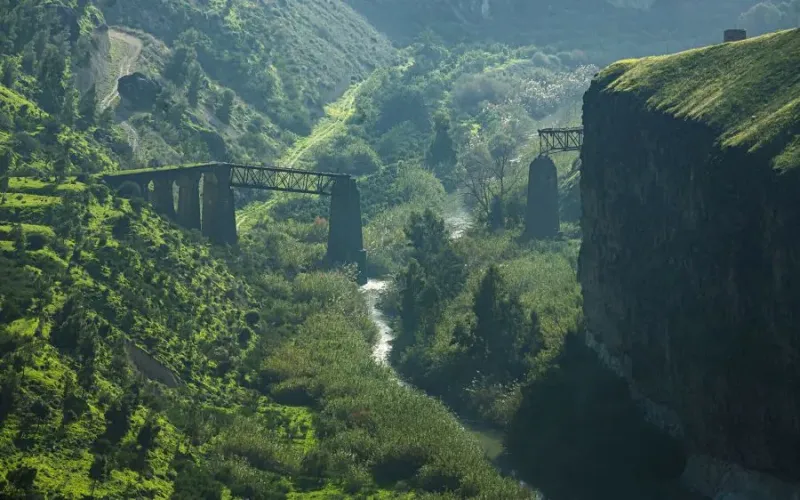
Within this context, the Yarmouk basin was supposed to be one of the pillars supporting Jordanian water security. However, the transformations that the basin has experienced over past decades—whether due to climate change or the expansion of agricultural activity in the upstream and downstream areas—have redefined its role.
Annual flows have declined to levels below fifty million cubic meters in some years, turning dams and related facilities, foremost among them the Al-Wehda Dam, from tools for storing abundance into facilities for managing what is barely available. With this decline, the focus has shifted to sharing the deficit and reducing losses rather than attempting to increase the share.
This shift gains additional significance when linking the Yarmouk to the Jordan River, as its main tributary, since any decrease in its flow directly affects the broader river system and the situation in the Jordan Valley specifically. Since the Israeli incursion into western Daraa countryside, the Yarmouk River has become a direct focus, representing the largest water tributary for Jordan. It is a shared water resource between the two countries and forms part of the northern eastern border of occupied Palestine, stretching 57 kilometers.
This water connection reflects the basin’s importance not only at the national level but also within the broader context of regional balances.
The Yarmouk is a vital element in securing Jordan’s water needs, especially given the scarcity of local resources and the high annual water deficit rates. For decades, the upper Jordan River has been subject to diversion and control policies that reduced its southward flow, contributing to the river’s deterioration, the decline of the Dead Sea level, and placing Jordan in a position of receiving the consequences of policies it was not actively involved in shaping. Thus, Jordan has become compelled to manage its water reserves with great caution, considering the impact of regional policies on its resources.
The water relationship between Jordan and Syria witnessed phases of tension during President Bashar al-Assad’s rule, despite the 1987 agreement that stipulated clear cooperation between the two parties. Jordan was supposed to build a dam with a capacity of 220 million cubic meters, while Syria built around 25 dams to irrigate its lands and benefit from electricity generated by the Jordanian dam.
However, the practical reality differed, as Syria during that period completed the construction of 32 additional dams along the river courses, in addition to drilling thousands of groundwater wells in its basin, which led to a reduction in water flow toward Jordan and halved the actual capacity of Al-Wehda Dam from 220 million cubic meters to about 110 million only.
This experience reveals how water challenges always intersect with politics, placing Jordan in delicate equations.
Here, the Jordan–Syria cooperative relationship over the Yarmouk intersects with the more complex and sensitive Jordan–Israel relationship, where water remains part of an unequal political and security equation. Although the Wadi Araba Agreement provided a legal framework to regulate the water relationship between Jordan and Israel, including supplying Jordan with specific quantities of water, the practical application remained closely linked to the regional political context.
With rising tensions in recent years, the fragility of relying on water arrangements tied to political agreements that could fluctuate became evident, strengthening Jordan’s conviction that water security cannot remain hostage solely to regional balances.
In this context, reactivating water coordination with Syria seems to have a dimension beyond the Yarmouk itself, representing an attempt to rebuild a limited regional balance in the water file based on technical cooperation, data exchange, and improving usage efficiency, instead of confrontation or unilateral approaches that emerged during former President Bashar al-Assad’s era.
Syrian reassurance is not read only as a bilateral message but as a shared acknowledgment that water scarcity has become an existential threat requiring collective management, especially given the declining resources across the entire region, from the Tigris and Euphrates in the north to the Jordan River in the south.
However, this cooperation, despite its importance, does not negate the fact that the Yarmouk can no longer play the role of a long-term strategic resource for Jordan. This explains Amman’s push toward major projects such as the National Water Carrier and desalination in Aqaba (providing 300 cubic meters), in an attempt to gradually disconnect from sources subject to political tension or climate change. Nevertheless, managing existing water relations remains indispensable, as any imbalance in one basin reflects on the entire system.
Thus, Jordan today faces a complex water scene, where a practical partnership with Syria to manage scarcity in the Yarmouk basin intersects with a conditional water relationship with Israel in the Jordan River and Wadi Araba, alongside an internal race to protect remaining groundwater reserves and build sustainable alternatives. At the heart of this scene, water becomes a silent battle over sovereignty and stability, managed with technical, legal, and political tools simultaneously.
Ultimately, the Yarmouk basin is no longer a front line or a point of dispute but a mirror of a wider regional crisis, revealing that the future stability of the Levant will not be determined by resource abundance but by the ability to manage scarcity fairly and rationally and build partnerships that protect peoples’ right to water away from the logic of domination or coercion.
In this difficult test, Jordan does not have the luxury of waiting. It continues to reshape its water security in times of scarcity, relying on realism rather than illusions, cooperation where possible, and self-reliance where necessary.