Israeli banks’ planned cut of Palestinian correspondent banking threatens West Bank economic collapse

07/27/2026 - 11:33
By Daoud Kuttab
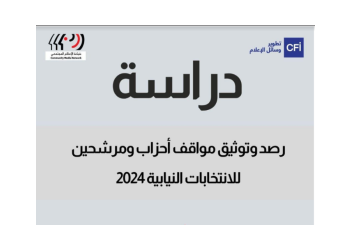
A major financial rupture is on the horizon for the West Bank after two of Israel’s largest commercial banks, Hapoalim and Discount, reportedly decided to suspend correspondent banking relationships with Palestinian banks operating in the occupied Palestinian territories. Adopting an integrated institutional framework, the study by Palestinian Engineer from Gaza, Dr. Dirar Abu Seesi, argues that this move represents a strategic inflection point and a tool of systematic economic annexation, not merely a technical banking adjustment.
The study recommendations urge the cancellation of the decision, immediate diplomatic pressure, and efforts to restore clearance revenue transfers alongside international legal accountability mechanisms. It also calls for activation of regional financial support mechanisms described as an Arab financial safety net, and for Palestinian emergency measures to unify institutions and explore alternative banking channels with international or regional partners. In parallel, it stresses humanitarian safeguards to prevent collapse of essential services, including emergency food and medical assistance.
The extreme Israeli measure, scheduled to take effect between August 13 and September 1, 2026, is presented by Israeli authorities as a response to legal and compliance risks related to anti-money laundering and counter-terrorism financing rules. However, an economic-strategic analysis of the decision warns that the cut would go far beyond banking administration, functioning as a lever that could paralyze trade, freeze government payments, and accelerate the collapse of public institutions, with cascading consequences for ordinary households, the private sector, and regional stability.
Correspondent banking is the mechanism through which Palestinian banks settle payments in Israeli shekels and access the broader financial infrastructure needed for commercial transactions. Palestinian institutions in the West Bank do not have direct access to Israeli or international payment channels; instead, Israeli banks act as intermediaries.
Through these relationships, a wide range of essential payments are processed, including settlement of commercial transactions between Palestinian businesses and Israeli counterparts, payment of wages for Palestinian workers employed inside Israel and settlements, and remittances that keep household spending functioning. The mechanism is also critical for essential imports—fuel, electricity, water, medicine, and other goods that depend on sellers being paid through the shekel payment system. The analysis argues that breaking correspondent links would make settlement in shekels unable to flow, producing delays or failures across the supply chain.
The report frames the current decision as a strategic inflection point in the Palestinian-Israeli economic relationship, tied to the legal architecture established under the 1994 Paris Protocol. Under that framework, the Palestinian Authority does not possess full monetary sovereignty: it cannot issue an independent currency and is instead dependent on the Israeli banking system as the primary gateway to external financial activity. Palestinian monetary authorities can regulate aspects of the financial sector, but they lack the tools to create a standalone payment infrastructure capable of replacing Israeli mediation quickly. This structural dependency means that correspondent banking ties are not simply commercial relationships between banks, but an operational pillar of day-to-day economic functioning.
The timing of the Israeli decision is also portrayed as politically consequential, arriving amid concurrent fiscal and institutional crises. Since May 2025, the clearing revenue system—through which Israel collects taxes and customs duties on behalf of the Palestinian Authority—has been suspended, leaving the Authority with a major shortfall. According to figures cited in the analysis, the accumulated deficit has exceeded 4.5 billion shekels, while the funds held by Israel related to clearance revenues amount to billions of dollars. On top of that, the Palestinian banking system has been accumulating large volumes of surplus shekels because of restrictions that prevent these balances from being returned efficiently to the Israeli banking system. The proposed severing of correspondent banking ties would worsen this imbalance, trapping liquidity inside Palestinian banks while cutting the ability to manage cash shekel operations and settle payments outward.
Economically, the report projects several mutually reinforcing disruptions. First is paralysis in trade settlement and the breakdown of supply chains. Israel is described as the West Bank’s dominant trading partner, with a large share of imports sourced from Israel. If shekel settlement fails, importers may be unable to pay for energy and other necessities. Electricity demand in the West Bank depends heavily on supply from Israel, and fuel and gas dependencies are similarly critical. As payment failures accumulate, suppliers could stop dealing with the Palestinian market, leading to shortages that extend from energy to medicines and food-related inputs. The analysis warns that debt accumulation among importers would accelerate supplier withdrawal, producing a rapid deterioration in availability of essential commodities.
Second is a liquidity crisis inside the shekel monetary circulation. The analysis suggests that Palestinian banks already face pressure from surplus cash shekels that cannot be fully repatriated through the Israeli system. Once correspondent ties are cut, banks would lose essential channels needed to manage liquidity. That could translate into shortages of cash shekels at exchange bureaus and branches, increased volatility in informal exchange rates, weakening confidence in the banking sector, and risks of deposit runs as depositors attempt to withdraw funds before balances become unusable.
Third is the disruption of the labor market and household income. The report cites an estimated 52,000 West Bank workers employed in Israel and settlements, who rely on salary transfers moving through the same banking infrastructure. If these transfers are interrupted, families would face immediate income loss during a period already marked by elevated unemployment. The analysis links this shock to a worsening demand contraction across the domestic economy, as households reduce spending on food, medicine, education, and healthcare.
Fourth is the threat to the Palestinian Authority’s capacity to function as an employer and provider. The Authority depends heavily on bank financing to cover deficits, and its debt to the banking sector is described as substantial. If local bank financing becomes inaccessible or unreliable due to the banking cut, the Authority’s ability to borrow and pay staff would be undermined. The report argues that salary payments are central to public administration and social stability, noting that the Authority had already reduced salary coverage and shortened working schedules in prior stages of its financial stress.
The analysis also emphasizes that the economic breakdown would occur within a political environment already strained by institutional paralysis, legitimacy problems, and heightened security escalation. It describes the West Bank’s governance as facing multiple existential crises: long-standing political stagnation, internal division among Palestinian factions, and a security environment marked by frequent military incursions, infrastructure destruction, and arrests. In such conditions, the banking decision could become a catalyst that deepens instability, strengthens pressures for unrest, and accelerates the erosion of public legitimacy.
From a political economy perspective, the report argues that banking decisions can serve as tools of deeper integration or coercive leverage. It claims that cutting banking ties could economically incapacitate the Palestinian Authority and enable direct dealing between Israeli entities and individuals or companies without the institutional mediation of the Authority. Such shifts could facilitate de facto Israeli influence over key aspects of life, while reducing the Authority’s administrative reach. The report also cites warnings from international institutions: the World Bank is quoted as viewing uncertainty in the Palestinian financial sector as a systemic risk that could lead to comprehensive economic collapse, while Palestinian officials are portrayed as warning that 2026 could be the most financially difficult year in the Authority’s recent history.
The projected social costs are described as wide-ranging. Government employees and their families are presented as among the most exposed populations, since salary cessation would rapidly reduce incomes for a large share of residents. The private sector would also be hit through import and export paralysis and disruption of cross-payments, potentially forcing many businesses to stop operations if they cannot acquire inputs or settle obligations. The report further warns that vulnerable groups would experience an intensifying humanitarian crisis, with worsening food insecurity as the ability to provide for basic needs declines.
Looking ahead, the 16-page study evaluates possible scenarios and assigns probabilities based on the likelihood and speed of repercussions. It presents a worst-case trajectory in which the cut triggers a complete collapse: trade halts, banking confidence erodes, withdrawals intensify, unrest increases, and the Palestinian Authority is effectively dismantled in practice. The analysis estimates this outcome at around 55–60% probability if no alternative mechanism is in place. A second scenario involves temporary extension or reversal due to international pressure or political conditions, estimated at roughly 20–25%. A third scenario involves a banking alternative—such as establishing an independent clearing arrangement or relying on another external banking pathway—but the report suggests this would face significant obstacles including time, approvals, and operational costs, estimating probability in the range of 15–20%.
In sum, the analysis portrays the planned suspension of correspondent banking ties as a high-impact intervention in the financial infrastructure of the West Bank—one that, if implemented without a substitute payment and clearing pathway, could rapidly trigger cascading economic failure. By disrupting settlement in shekels, blocking wage transfers, and threatening the flow of imports and government salaries, the decision could deepen an already fragile political and institutional landscape and reshape the functioning of everyday life for Palestinians across the West Bank.
Read full pdf report here